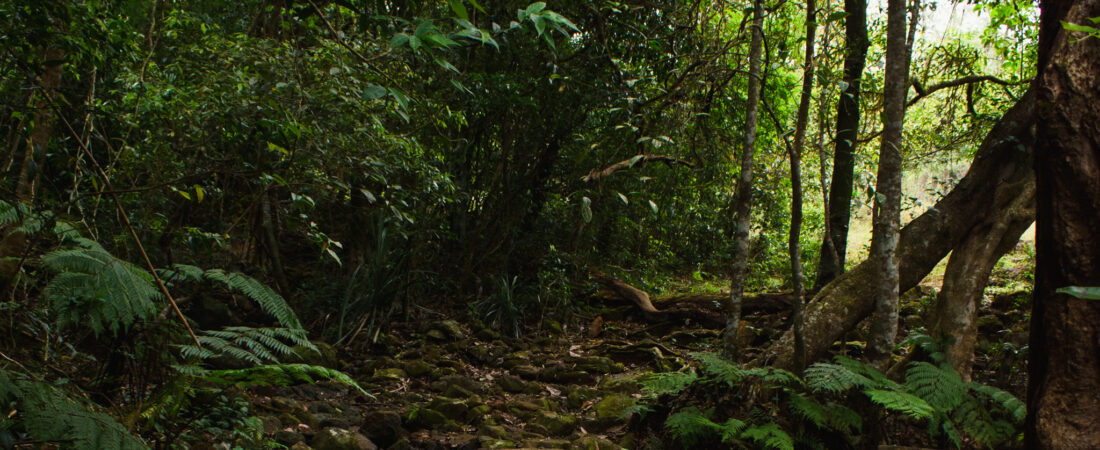
A kodimaram has gone up outside a kavu that didn’t have one ten years ago. It’s the tall ceremonial flagpole you’d expect outside a Brahminical temple, not a family shrine run by a Malayan or Vannan household. The puja is now conducted by a Namboothiri priest, in the spot where a hereditary local priest used to stand. The board at the gate says Devasthanam or Kshetram now, where a generation back it just said kavu. Even the offerings have shifted quietly: tender coconut water where there was toddy, milk where there was blood.
It happens slowly enough that most people who visit the same kavu every year don’t quite notice it happening. Researchers who study the sacred groves of North Kerala have been documenting the pattern for a while, though, and they’ve given it names.
What the researchers call it
There isn’t one single term for this, which is part of why it took some digging to find the right vocabulary. A 2024 paper by Filipe Pereira and Rajesh Komath, published in the journal Performance, Religion and Spirituality, uses three overlapping ideas to describe what’s going on. Templisation, a term coined by the scholar O. B. Roopesh, is the conversion of a grove or any non-standard place of worship into what Roopesh calls “a standardized form of Hindu temple.” Sanskritization is older, and comes from the sociologist M. N. Srinivas: lower castes adopting the ritual habits of the castes above them, vegetarian food instead of meat and toddy, a Brahmin priest instead of a hereditary local one, as a route to social standing. Hinduization describes something slightly different again: non-Hindu or pre-Hindu deities getting folded into the Brahminical fold, usually by being declared an avatar, or a subordinate, of one of the major Puranic gods.
These three things tend to show up together, though they aren’t really the same process. A kavu can be templised architecturally while its rituals stay mostly untouched. A deity can be Hinduized in name only, still worshipped the old way underneath a new label.
A kavu, before any of this, was never a Brahminical space. Joint families, caste communities, or tribal settlements ran these groves, not Brahmin priests. The rituals inside them could include animal sacrifice, arrack, and possession: teyyam performers and velichappadu oracles drawn overwhelmingly from the Malayan, Vannan, Pulayar, and Velan communities, groups that sat at the very bottom of the old caste order and were kept out of Brahminical temples for centuries. A kavu’s identity rested on being unlike a Namboothiri shrine. That’s the point of what’s being lost.
The details on the ground
Pereira and Komath’s fieldwork, done mostly around Thalassery and Payyanur, gets specific about what this looks like in practice, and some of it is almost mundane once you notice it. A Ganapathi puja, a distinctly Brahmanical rite, now opens nearly every teyyam kaavu’s annual kaliyattam, or the kaavu sets up some formal ritual link to the nearest Brahminical temple. Blood sacrifice gives way to milk and oil. Toddy gives way to coconut water. Malayan drummers have started wearing the mundu-and-gold-chain look that traditionally belongs to Marar, the caste that provides musicians at Brahminical shrines. Small carvings of Kurma, the tortoise avatar of Vishnu, now sit on oil lamps inside kaavus that had nothing like this before. Even the tottam pattu, the origin song sung before a teyyam transforms, keeps getting quietly rewritten, the paper argues, to fit local deities into a Puranic frame: an avatar here, a lesser figure under Shiva or Vishnu there.
Sabarimala shows the same thing at a much larger scale, stretched over a much longer time. The scholars Madhav Gadgil and M. D. Subash Chandran have pointed out that the hill itself, now visited by tens of millions of Ayyappan devotees every year, “could have originally been a sacred grove,” one of the Ayyappan kavus still scattered through the Western Ghats. The forest was eventually cleared for the temple that stands there today.
What also disappears with the ritual
This piece has been about caste, but there’s an ecological layer running through the same research that deserves its own space here. It isn’t quite the same story as the templisation above, and I don’t want to blur the two together.
Kavus, whatever else they are, function as small, dense pockets of forest. A survey of Iringole Kavu near Kochi, one of Kerala’s largest remaining groves, found more than 200 plant species inside it, 30 of them used in traditional medicine. Groves like it shelter species that have vanished from the surrounding cleared land, including the critically endangered Malabar civet, and help recharge groundwater in a state where water is becoming strangely scarce for somewhere that gets over 120 inches of rain a year.
The scale of the loss is stark. According to Kerala’s state forestry department, the number of sacred groves in the state has dropped from more than 10,000 to under 1,500 over the last sixty years. Much of that decline traces back to the same period as the land reforms mentioned earlier: the Kerala Land Reforms (Amendment) Act of 1969 and the Kerala Joint Hindu Family System (Abolition) Act of 1975 broke up large joint-family estates and, in the process, fragmented the groves sitting on them among multiple new owners. Iringole Kavu itself once covered 37,000 acres. It’s down to 49 today.
None of that is really about caste. It’s about land pressure, inheritance, and a grove classified as ordinary “revenue land” with no particular legal protection, sitting on property someone eventually needs to sell, farm, or build on. But it does intersect with templisation at one specific point: converting a kavu into a formal kshetram, almost by definition, usually means clearing ground for a built structure, a kodimaram, and a paved approach road. A 2019 Mongabay India report on groves in Kannur and Kasaragod put it plainly: some kavus “have grown to bigger structures,” with “wide roads and pavements… carved through forest patches” to reach them. One conservationist quoted in that report described a newer, more troubling shortcut some families take: performing prayers and offerings, cutting down the trees, and keeping only the deity in a corner.
Sabarimala, mentioned just above, is the largest-scale version of exactly this. The forest that gave the hill its original character as an Ayyappan kavu is gone, cleared long ago for the temple structure that now draws tens of millions of pilgrims a year.
Kodungallur, where the argument is still going on
The Bharani festival at the Kurumba Bhagavathy temple in Kodungallur makes this easier to see, because the conflict there has been public for more than a hundred years. The festival traditionally included theripattu, sexually explicit songs sung along the pilgrimage route, alongside a rooster sacrifice called kozhikkallu moodal, and kavu theendal, a ritual “pollution” of the temple carried out mostly by devotees from lower-caste communities, who would smear turmeric and coconut across the sanctum before the temple closed for a week of purification.
A study titled “Sanitising the Profane,” from TISS’s School of Media and Cultural Studies, documents an organized, upper-caste campaign against the theripattu songs specifically, calling them obscene, while structurally similar erotic material in Sanskrit devotional verse was never treated the same way. The rooster sacrifice is a separate story. It was banned across Kerala in 1977 under animal cruelty law, and today the ritual survives as a red cloth draped over stone instead of an actual killing. I’d keep these two threads apart. They had different stated justifications: public morality in one case, animal welfare in the other. Even so, scholars who study Kodungallur tend to read both as part of the same larger pressure to bring a non-Brahminical festival closer to upper-caste norms.
Why, and there isn’t one answer
Ask different scholars why this happens and you get different answers, and none of them are wrong exactly. They’re just looking at different parts of the same thing.
Srinivas, writing in the 1950s, thought lower castes pursued Sanskritization on their own, as a way to move within a caste system that otherwise offered almost no room to move at all. There’s a Kerala-specific case that backs this up rather neatly. The land reforms of the 1960s and 70s broke apart the old upper-caste tharavad estates and handed much of that land to tenant castes, the Tiyyas especially in North Kerala. Families that had never owned land before suddenly did, and some of them built new family homes modeled on the tharavads of the landlords they used to work for, kavu included.
Other researchers land somewhere else entirely. Mannarakkal Dasan puts more weight on the continuing economic and political pull of upper-caste patrons. Komath’s own work is blunter about money: a templised shrine draws more donations, more prestige, and increasingly more tourist traffic than a plain grove ever could.
Then there’s O. B. Roopesh, whose 2020 study looks at what Kerala now calls kshetra punarudharanam, “temple revival,” and how much space that phrase takes up in public life here: posters, flex boards, entire television segments built around temple festivals, in a state that still likes to think of itself as secular and left-leaning. Roopesh connects part of this to Hindu nationalist organizations, which treat temple committees as worth contesting because they see temples as the institutional core of a Hindu social order. Pereira and Komath add a detail from their own fieldwork that stuck with me: in parts of Kannur district, some kaavus now fly saffron RSS flags, while others nearby still fly red flags and pictures of Che Guevara. Groves that used to belong, without question, to one tharavad or one caste community are political property too now.
None of these explanations cancels out the others. It seems entirely possible for aspiration, money, patronage, and organized politics to all be working on the same kaavu at once.
What this does to teyyam specifically
We’ve written about teyyam on Unfold Kerala before, and this cuts closer to that story than I expected going in. A kaliyattam only works because of a caste inversion at its center: for the hours a Dalit performer carries the deity, caste hierarchy stops applying, and everyone, Brahmins included, bows to him. Pottan Theyyam, built entirely around Shiva testing Adi Shankaracharya’s prejudice, states that inversion outright as its whole point.
What the Sanskritization research points to is that the same ritual space, built specifically to suspend caste hierarchy for a few hours, is in some places being pulled back toward matching it instead. The deity’s story gets edited down into a Puranic footnote instead of staying an independent local god. The flagpole, the priest, the offering: each one quietly signals how close the kaavu now sits to Brahminical order. Teyyam performances haven’t stopped happening anywhere. It’s the frame around them that keeps getting redrawn, kaavu by kaavu.
One honest caveat on numbers, since the sources don’t agree with each other: earlier research on teyyam puts the count of documented forms at around 450. Pereira and Komath’s more recent estimate goes above six hundred. Nobody has ever finished counting, and both figures show up in sources worth trusting.
A different kind of response, and it shouldn’t get mixed up with this
It would be a mistake to treat every story about caste and Kerala temples as the same story. There’s a related but genuinely separate thread running in the opposite direction. In 1888, Sree Narayana Guru, who belonged to the Ezhava community and was himself barred from Brahminical temples, consecrated a Shiva idol at Aruvippuram near Thiruvananthapuram. It was the first known instance of a non-Brahmin doing so in Kerala. When Brahmins questioned his authority to consecrate a temple at all, he’s widely quoted as calling it “an Ezhava Shiva,” which is about as sharp a reply as I’ve come across to a question that deserved no serious answer in the first place. Aruvippuram wasn’t a grove being reshaped into something Brahminical. It was a temple built from nothing, by a community that had been shut out, as a claim to the right to consecrate and worship on its own terms. That’s the opposite direction of travel from templisation, even if caste and temple show up in the same sentence both times.
There’s a more straightforwardly legal chapter to this too. Until 1936, so-called “low caste” Hindus were formally barred from most temples in Travancore. The Temple Entry Proclamation that year lifted the ban, and the 1949 constitutional abolition of untouchability extended that right across India. That’s a story about a door opening. What’s happening to kaavus now is quieter and harder to pin down. It’s about what happens once you’re already inside a space that was never trying to keep you out to begin with, and about who ends up deciding what that space should look like once more people start paying attention to it.
Sources & a note on perspective
This piece leans mostly on peer-reviewed academic research rather than journalism. Here’s where each part of it comes from, and how solid that ground is.
The primary source is Filipe Pereira and Rajesh Komath’s 2024 paper, “From Grove to Temple: Effects of Sanskritization, Hinduization, and Templisation of Sacred Groves in the Ritual Performance of Teyyam, in North Kerala,” published in Performance, Religion and Spirituality, Vol. 6 (University of Toledo). Their fieldwork was done mainly around Thalassery and Payyanur, and most of the “details on the ground” section, the Sabarimala reference, and the RSS/Left flags detail all trace back to this paper.
The three core terms come from two places. O. B. Roopesh coined templisation and kshetra punarudharanam, in his PhD thesis The Makings of a ‘Temple Public’ (IIT Bombay, 2019) and in “Temple as the Site of Modern Contestations: Kshetra Punarudharanam in Postcolonial Kerala,” South Asian History and Culture (2020). Sanskritization comes from M. N. Srinivas, in Religion and Society Among the Coorgs of South India (1952) and “A Note on Sanskritization and Westernization,” The Far Eastern Quarterly (1956).
The Kodungallur material on theripattu and the campaign against it comes from “Sanitising the Profane” (TISS, School of Media and Cultural Studies). The 1977 rooster-sacrifice ban and the ritual’s current form are corroborated across multiple sources, including the festival’s own historical record.
The legal and historical background — the 1936 Temple Entry Proclamation, the 1949 constitutional abolition of untouchability, and Sree Narayana Guru’s 1888 Aruvippuram consecration — is standard, widely corroborated history rather than material drawn from a single source.
The ecological section draws on Diana Kruzman, “India’s Sacred Groves Are Disappearing, Taking Biodiversity and Culture With Them,” Gizmodo/Earther (November 2019), for the Iringole Kavu figures, the 10,000-to-1,500 decline estimate attributed to Kerala’s state forestry department, and the land reform connection. The “bigger structures” and “wide roads” quotes on North Kerala kavus specifically are from a 2019 Mongabay India report on sacred groves in Kannur and Kasaragod. One related piece worth flagging for anyone who wants to dig further: Nibha Namboodiri’s 2026 Mongabay India commentary on the kaavu avahana ritual describes newer, concrete-and-stone “kavus” that no longer function ecologically. That’s a related trend, but driven by family and land circumstances rather than caste dynamics, so I kept it out of the main text rather than imply a connection the sources don’t make.
One part of this piece should be read as a survey of live scholarly disagreement rather than a settled answer: the “why” section. Srinivas’s social-mobility explanation, Dasan’s upper-caste-patronage explanation, Komath’s economic explanation, and Roopesh’s Hindutva-politics explanation are four different researchers’ readings of the same pattern. They’re not mutually exclusive, but none of them is presented in the literature as the single cause, and I haven’t tried to pick a winner among them here.
Something worth keeping attached if this piece ever gets edited or excerpted: any statement connecting this pattern to Hindu nationalist organizations is attributed specifically to Roopesh’s research and to Pereira and Komath’s field observations, not stated as this site’s own conclusion.
Sources disagree on at least one clear number: the count of documented teyyam forms. Older material puts it around 450, Pereira and Komath’s more recent estimate runs above 600. Neither appears to be a completed census.
Kerala-born and raised, Bengaluru for the career, and Coorg has been home for the last decade. Lithin writes Unfold Kerala to explore — and stay connected to — the state’s history and culture. Follow the photography on Instagram @lithinphotography.