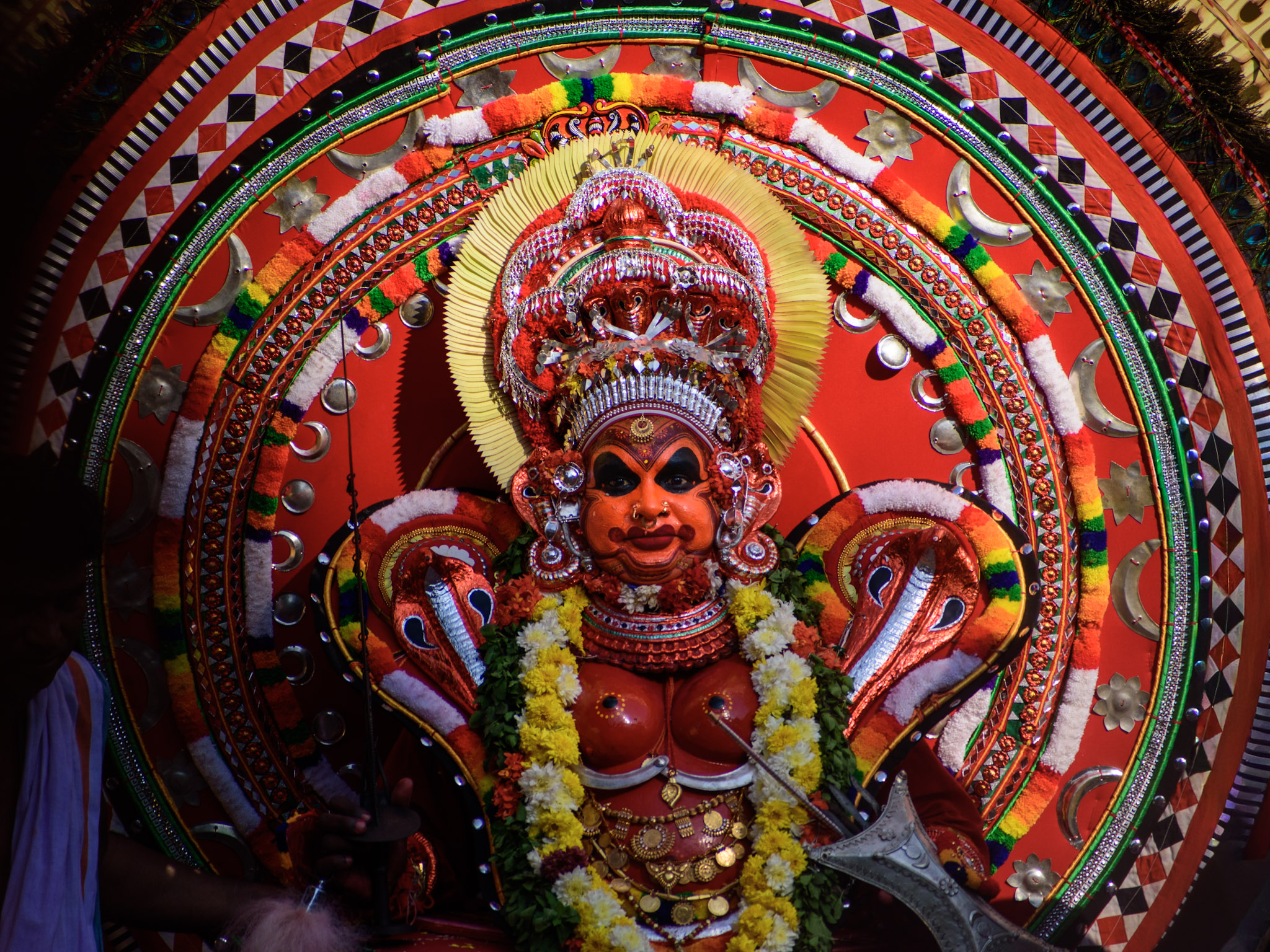
It’s past midnight in a village somewhere in Kasaragod. The air smells of burning coconut oil and crushed turmeric. A drum starts — slow, almost hesitant — and then another joins it, and another, until the sound stops being something you hear and becomes something you feel in your chest.
Then he steps out.
Face painted in fire-red and rice-white, a headdress rising taller than a man, anklets of bronze bells cutting through the drumbeat with every step. An hour ago, this was a man from the Vannan or Malayan community — someone’s neighbour, someone’s son. Right now, to every single person watching, he is God.
This is Theyyam. And if you’ve never seen it, no photograph really prepares you for what it feels like to stand in a crowd that genuinely believes the divine has just walked into the room.
It’s Not a Performance. It’s a Transformation.
The word itself is a folk twist on daivam — Malayalam for “god.” That distinction matters, because Theyyam isn’t theatre in the way we usually mean it. The performer isn’t acting as a deity. Somewhere in the hours of preparation — the fasting, the chanting, the placing of the sacred headdress called the mudi — something is believed to actually shift. The man’s own self is thought to recede, and the deity is thought to take his place.
People don’t clap when it happens. They fold their hands. Grandmothers who’ve seen this every year of their lives still whisper their problems to the figure in front of them — a sick child, a stalled marriage, a debt they can’t repay — the same way they’d whisper to an idol in a temple sanctum. Except this one looks back at them, and answers.
It sounds implausible written down like this. It doesn’t feel implausible when you’re standing there at 2 a.m. watching it happen.
A Tradition Older Than the Temples Around It
Theyyam’s roots go back further than most of the Hindu iconography layered on top of it today. Scholars trace it to the tribal and Dravidian spirit-worship traditions of North Malabar — long before Brahminical Hinduism arrived and folded local deities into a wider pantheon of Shiva, Vishnu, and the mother goddesses. Some researchers put its unbroken lineage at somewhere between 1,500 and 3,000 years, passed down almost entirely through oral tradition, family to family, generation to generation.
What’s striking is who kept it alive. Theyyam has never belonged to Brahmin priests or temple elites. It’s performed exclusively by specific communities — Malayan, Vannan, Pulayar, Velan, and a handful of others — most of whom occupied the lowest rungs of the old caste hierarchy. For one night a year, a family that might otherwise be denied entry through a temple’s front gate becomes the very thing everyone in the village, upper caste included, bows down to.
That inversion isn’t an accident. It might be the whole point.
The Story That Says It Out Loud
There’s one Theyyam that makes this explicit, and it’s the one I keep coming back to: Pottan Theyyam.
The legend goes that Lord Shiva, wanting to test the philosopher Adi Shankaracharya, disguised himself as a Chandalan — an “untouchable” man — and walked straight into his path. Shankaracharya, following the caste codes of his time, ordered the man off the road so as not to be “polluted” by his presence.
The disguised Shiva didn’t move. Instead, he asked him something simple: if you cut me, and if you cut yourself, isn’t the blood that comes out the same colour?
Shankaracharya had no answer. And by the time he realised who he’d actually been arguing with, the lesson had already landed — one that Theyyam performers have been singing and dancing out in village squares for centuries since, long before anyone used the word “equality” in a courtroom or a constitution.
It’s a genuinely radical piece of folklore, hidden in plain sight inside what looks, from a distance, like a religious festival.
Getting There: What a Night Actually Looks Like
A Theyyam performance isn’t a single dramatic entrance. It builds.
It usually opens with the Thottam — the performer, in minimal costume, singing the deity’s origin story to the beat of a hand drum. This part is easy to miss if you arrive late, but it’s where the real storytelling happens.
Then comes the transformation. The performer disappears for hours into a small enclosure to be dressed — face and body painted in patterns unique to that specific deity, using rice paste, turmeric, and charcoal; the towering mudi headdress, built from arecanut palm, bamboo, and coconut fronds, assembled and placed with its own set of chants.
When he finally emerges, something in the way he moves has already changed. The dance itself unfolds in stages called kalaasams — deliberate, escalating footwork building to a fever pitch, chenda and maddalam drums driving the whole thing forward like a pulse. Some Theyyams walk through fire. Some carry swords. All of them, eventually, turn to the crowd and start blessing people one by one — a handful of rice here, a smear of turmeric there, a murmured answer to a question someone’s been carrying around for a year.
By the time it ends — often near dawn — everyone in that courtyard has watched a man become, and then slowly stop being, a god.
More Gods Than You Can Count
There isn’t just one Theyyam. There are over 450 documented forms, each with its own deity, its own origin myth, its own costume and choreography. Muthappan, the people’s god, worshipped regardless of caste or religion at Parassinikadavu. Muchilottu Bhagavathy, born from a story of a wronged woman deified after her death. Gulikan, Vishnumoorthi, Rakthachamundy — each one a small universe of local history, family memory, and moral instruction, wrapped in paint and feathers.
North Kerala isn’t just watching a folk art form when it gathers for these festivals. In a very real sense, it’s keeping its own oral history alive — one that was never written down in any Sanskrit text, because the people who carried it were never given the pen.
If You Want to See It Yourself
The season runs roughly from October to May, peaking between December and March, almost entirely in and around Kannur and Kasaragod — with a handful of performances further out in Wayanad and northern Kozhikode. These aren’t staged tourist shows; they happen in kavus (sacred groves) and family shrines as part of that community’s own annual ritual calendar, which means dates shift each year based on the traditional Malayalam calendar.
A word of respect if you go: this is someone’s living faith, not a photo opportunity. Watch quietly, ask before you point a camera at anyone, and remember that for the people standing next to you, what’s happening in front of you isn’t folklore. It’s real.
Theyyam has survived a couple of thousand years without anyone’s permission to exist. It doesn’t need validation from outside Kerala to matter — but it’s the kind of thing that, once you’ve stood in front of it, you find yourself trying to explain to everyone you know for years afterward. This is my attempt.
Kerala-born and raised, Bengaluru for the career, and Coorg has been home for the last decade. Lithin writes Unfold Kerala to explore — and stay connected to — the state’s history and culture. Follow the photography on Instagram @lithinphotography.